
Watch 97% Owned - the new documentary featuring Positive Money which reveals how money is at the root of our current social and economic crisis.

Some campaigns are easier sells than others.

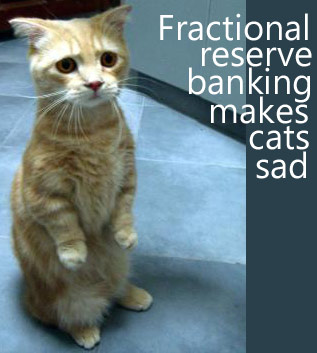
The easiest of them all has got to be animal shelters – “kittens in distress? Where do I sign?”

And at the opposite end of the spectrum, you’ve got the campaign to end fractional reserve banking.

So spare a thought for the good folks at Positive Money.

They’ve launched a campaign to end SOMETHING THAT MOST PEOPLE HAVE NEVER HEARD OF, fewer still understand, and even those who understand it don’t believe it.

I know. I tried to explain fractional reserve banking to my wife, and her reaction was “that can’t possibly be true.”

Most of us have a certain concept of banking in mind, that people put their savings into them and the banks then lend that money out to others. It’s how we understand it as children and because it sounds like common sense, it sticks with us. But that’s not how banks work.

In fact, banks don’t lend out savings. That accounts for just 3% of the money banks lend as loans or mortgages. The other 97% is just made up. It is, quite literally, written into being out of nothing. Banks don’t so much lend money as create money. Because the bank doesn’t deliver your loan as a big box of bank notes, but a series of digits in a spreadsheet, it’s actually very easy to do. The right to create money without the deposits to back them up is fractional reserve banking. It’s easy to see why people don’t always believe it when it’s first explained, so here’s someone else saying it:

“The money for a bank loan does not exist until we, the customers, apply for credit” says Ann Pettifor. “Reserves are created to support lending.”

You can probably see the problems with this already – after all, there are good reasons why it’s illegal to print your own banknotes. Nevertheless, banks created £266 billion in 2007. That was far more than was sensible, so in 2008 they created less than half that – and that’s why there was a ‘credit crunch’. Money was easy to borrow and then it wasn’t, and we’d all come to depend on easy credit.

That’s just the beginning of it. Consider for example, that you pay back your mortgage with interest. If that money belonged to someone, it would be fair that they were compensated for making it available to you. But since it was just made up, that’s all profit to the bank – the right to create money is a remarkable privilege. Now consider that you, through your taxes, propped up the banks when they abused this privilege. Time to end fractional reserve banking?

Fractional reserve banking is a crazy foundation to build an economy on.

It guarantees ballooning debt and instability.

It means money is infinitely available to those who already have lots of it, and hard to come by for those who need it most. It rewards risk taking and dis-incentivises caution. Because most of this invented money goes into property, it is the main driver behind the inexorably rising house prices that is slowly dividing society back into landed and landless classes. Unreformed despite its catastrophic failures in the last couple of years, it will let us down again.

There is no one solution to fractional reserve banking, but there are a whole bunch of measures we should take. We could start by separating investment banks from their high street services. We can create alternative currencies. The right to create money could be broadened, with more smaller or local banks, credit unions and business groups, or local government. Ultimately, if the banks can create money, so can you or I. It would take a whole post to explain why this isn’t a ridiculous suggestion, but genuinely – one day we this will be possible, and it will be so common sense that children will understand it. (See my review of Thomas Greco’s book The End of Money for a start).

In the meantime, check out the Positive Money website for lots more on fractional reserve banking, explained a little better than here. Sign up for their newsletter, and support a campaign that has a mammoth task ahead and no fluffy kittens to help them out.

Then again, since most people don’t know what fractional reserve banking is, perhaps it’s worth a try?

  • RJ

    No wonder your wife can not understand. There are so many confusing, misleading or wrong statements in this post.

    “The right to create money without the deposits to back them up is fractional reserve banking”.

    No it is not. Credit and deposits actually go hand in hand. Bank credit always creates an equal deposit. see down the bottom of this post

    This statement is also not correct

    “If that money belonged to someone, it would be fair that they were compensated for making it available to you. But since it was just made up, that’s all profit to the bank ”

    The profit to the banks is based on NET interest. Every credit transaction always creates a matching deposit as explained above.

    “Fractional reserve banking is a crazy foundation to build an economy on”

    Not correct. And 100% backed commercial credit to base money/capital is just fractional banking at a 50% level rather than say 90%. The recent problems occurred because banks were not regulated and went as high as 99%. Or above 100% and funded LT lending with ST finance. So the fractional banking limit was almost completely ignored.

    “It guarantees ballooning debt and instability.”

    Wrong again. This only happens if the fractional banking restrictions are ignored and banks are allowed to make excessive profits.

    I agree with banking reform. But reformers must understand the current system and the real problems as a starting point.

    And here is an explanation for one transaction. Credit and deposits always go hand in hand as explained on a previous post

    http://www.positivemoney.org.uk/2011/07/what-exactly-is-full-reserve-banking-2/

    What is a bank deposit? It is just the other side of bank credit.

    So if Person A obtains credit from bank A. Then person A ends up with a debt liability to bank A. And bank A end up with an assets (loan to person A) and a liability (money to be settled).

    Lets say person A uses this bank credit to buy an asset from person B. B then banks this money with bank B. So person B now has a deposit (asset) with bank B. And banks B has an asset (settlement account) and a liability (customer deposit).

    Bank A now has to settle with bank B. And what is used to settle? Usually central bank credit.

    So where does this central bank credit come from. The answer is from Govt deficits. And why do banks accept this credit (in exchange for real good and services purchased by the Govt) when it is simple created from thin air (by JE)? Because we need to pay our taxes so this credit has value.

    So Govts need to run deficits to create the asset for commercial bank to operate. So that we can all pay out taxes back to the Govt (banks use central bank credit to settle with the Govt).

    We no longer have money supported by gold. Yet many still seem to have not yet grasped the aignificance of this change.

    Money (commercial bank credit) today is created from thin air. As is the asset (central bank credit or Govt bonds) banks use to settle with each other, and provide capital to support lending. A country with their own currency can never run out of money (credit) when debt is dominated in that currency.

  • RJ

    One further point.The current money and banking system is much better than the old gold backed system.

    With smallish adjustments it could create full employment and largely eliminate boom and bust. But moving to 50% fractional banking (or some variation to try and achieve the same thing) is completely unnecessary and would possibly make the system worse not better.

    • gnuneo

      RJ, i agree with most of your criticisms, However your model is flawed, it seems to me, in a simple manner. You appear to follow a ‘banking system model’ that is essentially a closed-system, including Govt?

      yet money channelled through ‘tax-havens’, and ‘laundered’ back into circulation, often through ‘the war on drugs’-supported drugs barons, using deliberately corrupt financial instruments and groups, leaving the regular channels of tax, and re-entering as inflationary spending. And incidentally, making already very wealthy and ‘connected’ people even wealthier.

      now, i agree that FRB is not necessarily a ‘bad’ thing, anymore than the Gold Standard was. And i certainly agree that the Banks require far more regulation. Don’t mistake me.

      i just am concerned you *may* have overlooked a complexity in a simple model.

      from the original article: “We could start by separating investment banks from their high street services. We can create alternative currencies. The right to create money could be broadened, with more smaller or local banks, credit unions and business groups, or local government.”

      makes a very great deal of sense.

      • gnuneo

        oops!

        “yet money channelled through ‘tax-havens’, and ‘laundered’ back into circulation, often through ‘the war on drugs’-supported drugs barons, using deliberately corrupt financial instruments and groups, leaving the regular channels of tax, and re-entering as inflationary spending (and incidentally, so that already very wealthy and ‘connected’ people can be even wealthier), makes your “closed model” view of banking highly questionable.”

        corrected, sorry.

      • RJ

        There is only two form of real money. Gold or any asset or service could be used as a medium of exchange (a hours labour for food for example) and I guess could count as money but really money is only

        Notes and coins and
        Commercial bank credit

        Notes and coins are printed as required. Commercial bank credit is loaned into existence. This always creates a customer debt and an equal customer deposit. (But with different interest rates).

        Banks settle though the central bank. They use central bank credit to settle with one another. Central bank credit along with Govt bonds, come into existence when Govts run deficits.

        So the capital for banks (CB credit and Govt bonds)and around 97% of money is simple created from thin air (by a JE). The other 3 or so percent is simple printed as required.

        All the other points you raise relates to the use of this money or credit or is an asset. Cash or credit can be used to buy another currency. And I consider financial securities as an asset (similar to any asset)that can be converted to money to spend, or I guess used to exchange directly with another asset or service. So similar to money in this respect but not money.

  • Dhavar

    RJ
    “Credit and deposits actually go hand in hand. Bank credit always creates an equal deposit.”
    So what? And if you think that actual money, real cash by all means you may use right know to buy whatever it pleases you, is the same than the promise of giving money sometime in the future you certainly have a serious problem. They certainly go, but not at all “hand on hand”. But that is only one side of the issue.

    The centre of the whole thing is:

    What exactly do you mean by “always creates”? That is exactly the difference between yourself, loaning money to somebody,giving away your own money, and a banker, upon which, as you have said, the right to “always create” an equal deposit have been bestowed upon”.
    And “create ” means exactly that: Create.That money did not exist nowhere prior to making the loan, but is “created” when the banker plays “enter” on its computer and puts that money in your account. The so called “reserves” only establish the maximum quantity the bank is able to CREATE – as you have very aptly and correctly said- on any given moment, for himself and for his only benefit, using the right to CREATE MONEY. GRATIS TOTAL. And loaning is not the only way they CREATE money:They buy stock, government bonds, whatever.
    Think: What is the key difference between your computer and the computer of a bank? Why aren´t you able to “CREATE deposits that go “hand on hand” with the promise fo the borrower to give them back plus interest in the future?I give you a hint: It is hidden in some secret marvelous material the bank computer chips are made of.Search for it. If you find it, you will be able to become a banker.

    • RJ

      “So what”.

      Because Jeremy (and he is certainly not the only one) seems to not understand this point or the implications that flow for it.

      And you seem to have a problem with commercial banks providing banking services and creating a valuable asset (commercial bank credit). I don’t as long as the allocation of licences is fair and economically sound, banks employ suitably qualified staff, they are adequately and appropriately regulated, are punished for illegal activities and new legislation or controls are introduced as necessary when problems arise.

      But this applies to any provider of goods and services. With tighter controls required the more important the goods or service.

    • http://www.sarovic.com Aleksandar

      Well Dhavar, if banks do not have money behind this creation you would not be able to pay anything with this creation.

  • Dhavar

    Aleksandar:

    Well, they do not have any thing behind. They simply create money, issue money, for they have been awarded the license to do so. The number inputs that are registered in your bank account when you receive a loan have FULL LEGAL TENDER for the settlement of any payment, fine or tax. THEY are MONEY. There is not another class of stuff behind.Their computers are exactly the same as a printing machines.
    And then you sign in a document that you will repay them the whole principal they have created at NO COST, OUT OF NOTHING, plus INTEREST. (Why “interest”compensating for what?, by the way)
    We live in a system of a LEGALLY ESTABLISHED MONOPOLY OF PRIVATE MONEY CREATION.(A tragic oximoron in itself)
    Money, the fundamental institution of Civilization,that is created by the acceptance of all that is expressed through the LAW in the legal tender, and therefore derives its power of being exhanged agaisnt all richness and life forces from the whole society, is not simply a “public good” such as the air. Is the essential PUBLIC GOOD, the fundamental agreement that founds any society.
    Now we see in fornt of aour tired EU eyes the clear show of our own elected gtovernments begging for money to the same people they stupidly granted the power to issue money, as a debt with interest, granted by the whole richnesses, sweat, life and blood of ourselves.
    Is incredible.Would you dare to say “the king is naked”? That is , THE ABSOLUTE MONARCH FOR HIS SOLE BENEFIT, THE BANKER, IS NAKED?
    Because we do not live in any kind of “Democracy”, since our elected governments have to beg for money to un-elected and private groups.
    We simply live , from 1694 (Bank of England creation), in the oldest of systems: The Feudal Banking Oligarchic Putocracy, created by the USURPATION of the first prerrogative of a State, the issue of money, to private groups.

    So, you can have this current system fo Private issuance of money and the absurd, enslaving and nightmarish world we live in, or you can have Public, . ie, Law issuance of money.
    You can´t have both.
    That is the order of the battle. The only real battle held througout the history of mankind since Sumer cities were Civilization was born.

    • http://www.sarovic.com Aleksandar

      Only central banks can create money. I am starting to believe that the whole story of creation money out from nothing is part of the conspiracy of the rich people. Then they may say all attacks against us are false, we are just hard working people. The point is they earn money through interests for nothing everywhere. They cannot create value they just tax values other people produce. They tax the whole world through interest and create inflation with it. They earn interest from you even if you do not loan money from them because producers loan money from them and then had to repay loans with interest. Whatever you purchase you pay the interest included in prices. They bribe you people with small interest for your savings which hardly cover inflation they produce. In that way you hardly save the value of money you deposit to banks. Those who do not save money lose money through inflation banks create. Inflation makes money worth less every day. Banks charge the whole world with interest and that is how they make money. They do not need to create money out from nothing because they earn enough money through interest. But also they could not create money out from nothing. So how to escape from banks very easily? If governments loan money with no interest, banks would lose the chance to charge interest and money could have the same value forever.

    • RJ

      Dhavar

      “(Why “interest”compensating for what?, by the way)”

      To cover the cost of

      Running the bank
      The risk that a customer might default
      Cost of capital and interest on the deposit needed to cover this loan

      And the euro countries are in a totally different situation to the US as they no longer control their own currency. They are in a much worse situation and are more like US states but controlled by foreign undemocratically elected bureaucrats and bankers.

      • http://www.sarovic.com Aleksandar

        RJ, you forgot the main reason. Interest makes bankers enormously rich. Their wealth allows them to corrupt policy that supports the rich.

  • Dhavar

    Aleksandr:

    “Only central banks can create money”. That statement is simply not a fact, is a mistake.The Banks themselves admit that they create money.Nobody well informed denies this.
    Besides, there is the evidence before your own eyes whenever you receive a loan:Ask the Banker if the money given to you was in a count such as it will be in case you loaned money to someone, thus reducing your availability of money temporarily.The best way to understand this issue is to see the difference between a “normal lender” and a Banker.
    The lender gives you 5$.Now you have them but he has not.Total quantity of money in your town remains the same. When the banker gives you 5$, simply printing them – as is the exact case -, he is not deprived of the same 5$ he had on wherever. Then, the total quantity of money in your town is increased by 5$.You have 5$ more at your disposal and NO ONE has surrendered the availability of the same 5$.

    • RJ

      Dhavar

      “When the banker gives you 5$, simply printing them – as is the exact case -, he is not deprived of the same 5$ he had on wherever. Then, the total quantity of money in your town is increased by 5$”.

      This is very misleading.

      A commercial bank does not just create an asset out of thin air without a matching liability.

      Whenever a commercial bank loans money. An asset (loan to customer) is generated. But so to is an equal value liability (customer deposit). With either the same or another bank. If with another bank then the lending bank would lose the $5 central bank credit as part of the settlement process.

      • http://www.sarovic.com Aleksandar

        OK -Banks do create money with interest but when I say it people here shout on me that I am wrong so that I lowered down my statement. When a bank gives me loan of $5 and I buy an ice-cream with this money the $5 will be possessed by the ice cream maker and nobody else.

        The same money could not be used twice by the same owner. I’ll try to explain what that would mean mathematically. If one dollar could be used just twice in a day by a bank in the way you say it, and the next day 2 dollars produce 4 dollars, and the next day 8, etc., after 60 days it would generate such “wealth” that all banks around the world together do not possess today. Try it with your computer. Just multiply by 2 whatever you get 60 times. Inflation would be enormous. But inflation is always close to the interest rate. Why? Banks earns money through interest not by money creation out of nothing, and interest is the main reason new money is created in today’s world. Interest is the main reason for inflation.

        • Nic the NZer

          Aleksandar, please pay attention. Say that the bank gives you a loan of $5, lets assume on your credit card, then their credit card scheme is backed by some retail demand deposits. This means that once you have purchased your ice cream both the person having the demand deposit and the ice cream vendor can now access and spend $5 of the same money. The bank is betting that the $5 gets back to the bank before the deposit holder want’s it back, and usually they are right. However until you pay off your credit card there is potentially $10 in circulation, both backed by the same $5.

          • http://www.sarovic.com Aleksandar

            Sorry Nic I did not get it. If I buy an ice-cream by using my credit card, the ice-cream maker gets paid immediately $5 from the Bank minus the bank charge which is about 2%. I need to pay $5 in let say 1 month. Where is $10 in circulation here?

          • Nic the NZer

            Because there is a bank depositor whose money is used to back the credit card scheme as well. They can withdraw their money from their demand deposit account. This is the other $5, along with the $5 taken by the ice-cream vendor. Until you pay off your credit card $10 is in circulation split between bank depositor and ice-cream vendor. Credit cards are a form of loan.

          • http://www.sarovic.com Aleksandar

            No problem. Ice-cream vendor is paid and out of the picture. I owe to the bank depositor (or bank) $5. They already received interest 2%. And in a month I would pay $5.There is no $10 in circulation here. And even if this $5 circulates 10 times, and produce wealth of $50, it would still be $5 in circulation.

          • Nic the NZer

            Clearly Aleksandar the other $5 is in circulation until you settle your credit card debt in one month.

            Money you owe in the future can not be counted in the same pile as money you can access immediately.

      • João Granchinho

        @RJ
        “This is very misleading. A commercial bank does not just create an asset out of thin air without a matching liability.”
        It’s not misleading at all. It’s that simple. Call it what you will RJ. Saying that a bank creates money out of thin air but then also creates a matching liability doesn’t change at all the fact that it DOES create money.

        Mr. A deposits 100$ in his bank account. The bank takes 10% out of 100$ and keeps that as reserves (in cash), in case Mr. A wants to withdraw some of his money, and lends or invests the other 90$. With the initial 100$ in the economy, there are 100$ on Mr. A’s bank account, with which he can buy goods and services (with his credit card for example), and there are another 90$ which the bank either loaned to someone else or invested. If this were done with live cash (or gold, something other than representations like cheques, or digital money) it would be impossible for the bank to guarantee Mr. A’s 100$ for him to be immediately able to buy goods and services and lend 90$ at the same time, without printing money into existence. I stress the point that despite the bank seeing Mr. A’s 100$ as a liability (cash the bank owes to Mr. A), the numbers in his bank account effectively constitute money – a credit card is just as good as hard cash as far as consumers are concerned. This process of deposit multiplication goes on.

        Do you deny commercial banks create money out of thin air whenever they make a loan? Do you deny that if the speed at which old loans are being repaid is slower than the speed at which new loans are being made, inflation goes up? It’s simple Maths. Misleading you said. I say misleading is that double entry book keeping.

        To see more about double-entry booking see Franz Hörmann, Professor at the Economics University in Vienna:
        http://derstandard.at/1285200656759/derStandardat-Interview-Banken-erfinden-Geld-aus-Luft

        • Steve

          Joao,

          “I stress the point that despite the bank seeing Mr. A’s 100$ as a liability (cash the bank owes to Mr. A), the numbers in his bank account effectively constitute money”

          The numbers in the bank accountconsitute ‘broad’ money only. Broad money is not legal tender and can only be honoured if there is no central bank money to back it up.

          So if a bank runs out of central bank money (its reserves) it can no longer satisfy its broad money liabilities and the debit card would not work nor can depositors with draw money.

          As a illustrator – imagine electricty generation. The equivalent of broad money would be the level of electricity to meet if everyone simultaneously demanded the maximum. The equivalent of central bank money is the actual amount being generated by the power companies.
          Banks are always managing the balance between what they actually have and what the demand will be from their total.

          • RJ

            “The numbers in the bank accountconsitute ‘broad’ money only. Broad money is not legal tender and can only be honoured if there is no central bank money to back it up.”

            This is not correct. It is legal tender

            Commercial bank credit is very real money (more so than central bank credit).

            Central bank credit is an asset that is created (out of thin air) by a central bank. It is used by banks to settle with other banks. If one bank is short they can purchase the required CB credit though the countries central bank.

          • Steve

            RJ,

            I made the correction to remove the word ‘no’.

            Broad money is convertible to legal tender but in itself does not consititute legel tender. You cannot buy anything directly with your bank deposit – it first must either be converted into cash or the case of a debit card transaction a transfer between banks will take place of reserves which is central bank money.

            If a bank runs or of central bank money then it cannot honour its deposits – usually the bank of england will step in as lender of last resort and lend the bank reserves, taking assets as collateral.

          • Nic the NZer

            I don’t think that a bank would ever refuse a depositor unless they ran out of physical notes and coins.

            They are likely to take a loan or central bank loan when they are below reserve, and this probably happens at the end of the day. My idea of the details here is very vague though, I would not be surprised if you knew better.

          • Steve

            Nic – banks can and do go bust and not just because they run out of physical cash. Hundreds of banks have been shut down in the US over the past few years.

            Banks can borrow money over night from the Bank of England but at a high rate of interest and they have to put high quality assets aside as collateral – usually government debt.

            I can recommend that you read the “Red Book” from the Bank of England. It shows how they provide monetary stability and illustrates the instruments they have.

          • Nic the NZer

            More like attempt and fail to provide monetary stability in my assessment. The previous crash on a similar global scale was less than 80 years ago.

            25-100 times debasement of monetary value is also not a great record of stability.

            I ask you for example why a Greek (just 3% of euro zone economy) default is considered as a possible cause of another global banking collapse. I would give the system less than pass marks for financial stability.

          • Steve

            Nic,

            I certainly can’t disagree that in the last few years the BoE have made a pigs ear, although they did have a lot of their additional controls taken away and given to the FSA who failed abysmally.
            However, I was more referring to the red book as a useful indicator of the specific methods they use. It is extremely useful in understanding how the central bank operates in the banking system.

            In terms of debasement of the currency. The money supply should increase in line with economic growth – additionally central banks target modest inflation through growing the money supply.
            Without looking it up, I suspect over the last 80 years the economy has grown by between 3 and 4% annually on average. Add in inflation target at 2% and money supply should have grown between 5 and 6% per year. Over 80 years, 5% growth is 40 times and 6% growth is just short of 100 times.
            Clearly in the last 10 years we have had excess growth and so money supply is probably still above where it should be versus GDP, hence it is currently shrinking.
            Going back to the original point, the BoE and other regulators had their eyes closed to thie excess growth.

            I honestly don’t know whether a Greece failure woulf bring down the system – I suspect other than the Greek banking system probably not (although I suspect some individual German banks would be at risk). However I suspect the fear is if Greece passed the contagion to Portugal and then to Spain, it is then there would be problems. That is a much, that so many Eurozone countries are on the edge as it is the banks are interconnected. Not many systems can survive severe stress in multiple places.

        • http://www.sarovic.com Aleksandar

          JoO,
          I deny that commercial banks create money out of thin air ever. The sample you use is just a mind game. These 90 dollars which bank could lend extra would be lent only if the bank has assets of 90 dollars to lend. If the bank does not have it then it could not be lent because it does not exist. The point is banks could not loan money they do not possess.

          • Nic the NZer

            Mr A deposits $100 into a bank account. The bank makes a loan of $90 to Mr B.

            So after making this loan Alexander the combined total of demand-deposits in both accounts of A&B will be $190. We assume that both Mr A & Mr B will be able to withdraw and use their money. Where has the extra $90 come from?

            Banks can’t loan money they do not possess but they can’t guarantee that the depositors whose money they loaned will get their deposit back any more.

            Point number 2, until the loan to B has been paid off this is inflationary as both A and B can spend their deposits.

          • http://www.sarovic.com Aleksandar

            I think the capitalist world solves such problem in the following way: If Mr. A withdraws money before Mr. B tries it Mr. B would not be able to do it without matter the bank offered him a loan because the bank would not have money to give him. No problems here. If Mr. B withdraws money before Mr. A, and Mr. A wants to withdraw his money, then the bank would not have it and would face bankruptcy unless it would be able to borrow money somewhere else and give it to Mr. A. The point is money could not exist if it is created out of nothing. It must be backed up.
            I think even money which is created out of thin air by central banks, loaned and after that returned back could not bring inflation.

          • João Granchinho

            Aleksander, it does seem like a mind trick doesn’t it? It is mind boggling.
            I invite you to analyze my example thoroughly. You will find I applied the fractional reserve rules, there is no trick anywhere. This deposit multiplication is a known effect of FRB. You can find out more about FRB and deposit multiplication for example on wikipedia:
            http://en.wikipedia.org/wiki/Fractional-reserve_banking#Example_of_deposit_multiplication

          • Steve

            Nic,

            “Mr A deposits $100 into a bank account. The bank makes a loan of $90 to Mr B.

            So after making this loan Alexander the combined total of demand-deposits in both accounts of A&B will be $190. We assume that both Mr A & Mr B will be able to withdraw and use their money”

            That is where you are going wrong by assuming they can both withdraw and use their money. They cannot – there is still only $100, there just happens to be claims (deposits) on $190.

          • Nic the NZer

            In my example Aleksandar I didn’t expect that the amounts 100 and 90 pounds would the bring bank into bankruptcy, this is kind of secondary. The point is that if I asked you how much money you had immediate access to you would count the number in your bank account, and any cash you held. The money that A & B have in total has increased. Notice that B owes a loan, but this is a contract, not money.

            As you said it must be backed up, so what is it being backed up by at this moment? What is the impression that A & B can access their deposits based on? Well it’s the idea that the bank will remain solvent until they have done so, so basically the impression that the present state of liquidity of the bank can persist, maybe perpetually so. It would be incorrect to assume that the bank will always have money flowing in to support it’s depositors.

          • http://www.sarovic.com Aleksandar

            Joao,
            OK you proved by that example that banks could create money, but it is still a trick, because the sample is useless.

            http://en.wikipedia.org/wiki/Fractional-reserve_banking#Example_of_deposit_multiplication

            In your sample assets grow but liabilities grow as well, I would say even faster because you did not pay attention to interest. Who is going to pay 10 interests on the same money? Banks could not make money from that.

          • Simon

            The banking system creates more money when an initial £100 deposit can seed say a further £1000 in loans and deposits throughout the banking system. The money supply declines when loans are re-paid although interest has to be found as well, usually by the issuance of further loans (plus interest)

          • Simon

            The problem usually arises when the loans are created faster than they are re-paid, and to people who cannot re-pay the loans. The loans have been made for the wrong purposes, mainly to ramp up property prices. I think the Bank of England has finally woken up to the fact that it needs to look at where loans are made, not just the price of money through the interest rate. There are many other problems with a debt based money system, which are highlighted on this site.

  • Steve

    Mistake – remove the word no from…
    “can only be honoured if there is central bank money to back it up.”

  • Dhavar

    But apart from details, the dividing line is, as always have been, Public Money/Private Money.

    And why shouls not “everybody” be granted the license to “enter legal tender money” in his computer? (think a bit, please)

    China, throughout 2000 years ancient History, Rome, from the very beginning until their turning point – more than 800 years – Sparta, Cartague, ALL the strong, free and prosperous nations of the history have had NOMISMA OR NUMMUS money, that is, a creation of the whole society, backed by the whole society,created by Law and only by LAW, to assist and make feasible the order of civilization, being such agreement bestowed and expressed in the word of the LAW, ie. : “FIAT NUMMUS”.
    But, from the very begining, there arose the “wise guys” who wanted to usurp that PUBLIC POWER FOR THEMSELVES.
    For example, the code of Manou ordered that if the agent of the temple- then at the dawn of Civilization, the Temple-Cities where the centre of everything- used the credit of the temple and the city to produce false receipts for his benefit,to be cut the arms and the legs using a razor.
    The antiquity had a really acute sense of the destroying force, the CANCER – literally – of private appropiation of money, in which the whole forces of life were represented and agreed by all for the benefit of all.
    And that is the real meaning of the so much famous escene of the gosspell, the only one in which the wandering Jew really shows overwhelming anger. It was not a question of:This is a place to pray, do not make bussiness here.
    It was the eternal question of the usurpation of the centre of the life forces of a comunity by a gang of thieves, of “fraudulent issuers” of the money. On that days, the temple was the Estate, the Warehouse of the whole Community and the Center of his life.

    • Steve

      Dhavar – you can set yourself up as bank if you so desire. You can take deposits and lend out that money keeping a fractional reserve. As long as you can keep a balance between the demands of the depositors you owe to and the repayments of your borrowers you have no problem and you’ll be acting in the same way as a bank.

      Having a bank licence means essentially the following things..
      - You will be regulated by the FSA
      - You will have to report your financial information to the bank of England.
      - You can apply to use bank of england facilities.

      There isn’t much else – it certainly doesn’t give you any magical powers.

    • http://www.sarovic.com Aleksandar

      I agree with you Dhavar that public money would be much better solution but the rich people have make people used to private money and now it is very hard to change it. I propose public money and could not get support.

      • RJ

        Why is public money a much better idea.

        Commercial banks work well if regulated adequately. In much the same way as food manufacturers etc. But when Govts fail to enforce sensible restrictions on them or protect very poorly run banks (rather than nationalising and only protecting depositors money) then problems occur.

        Supporters of public money often have no idea how the current banking system works, what the problem are with it and how it could be modified to achieve better results like full employment quite easily.

        It’s flawed beliefs and ignorance or misunderstandings that is the problem. One flawed belief is that Govt debt matters. It does not in the slightest if a country has their own currency.

        • http://www.sarovic.com Aleksandar

          Philosophically speaking people produce wealth and not private capital. Private capital could not earn one cent without people who represent public and buy it. Secondly private bank capital does not produce values, it just tax values which public produce. Public banks and private banks work the same way. The only difference is whether profits go to public or to private pockets! More just and morally correct would be public money. And the most just and most morally correct would be public money available without interest.

          Government debts matters a lot because it must be covered and that produces inflation. People buy less with the same salaries.

        • Simon

          The best advantage of public money is that it could be created interest free, saving a huge amount for the tax payer for a start. Inflation would be kept under control as new money would be issued free from political influence. The private banking system has created huge inflation and a world wide debt burden – debt slavery

  • RJ

    Steve

    I’m unsure why you have made this statement

    “You cannot buy anything directly with your bank deposit”

    We can and do. Cash is hardly used any more

    You need to drop the idea of real money. Money today is mostly no more than a series of JE’s. Both commercial bank credit and central bank credit are both created out of thin air (JE’s) as required.

    Central bank credit (and Govt bonds) is an asset created without a meaningful or real offsetting liability. The Govt uses this asset (created from thin air) to buy real goods and services (by running a deficit). This asset (CB credit and Govt bonds) has value because it is needed to pay taxes back to the Govt.

    Commercial banks create credit when required out of thin air as well but every asset is always offset with an equal liability.

    It’s the significance of this difference that many fail to grasp. The Govt already has all the power they need. Only ignorance hold them back from achieving full employment for example.

    Read up on modern monetary theory for more. There are many sites or articles on this (it was called chartalism) but here is one

    http://moslereconomics.com/support/

    • Steve

      RJ,

      The majority of broad money is comprised of deposits. Deposits are merely a liabiliy owed by the bank to its depositors. A deposit categorically does not consitute legal tender.

      If someone pays with a debit card, or bank transfer that transaction is settled between banks via a transfer of central bank money (i.e. from thne banks reserves). If a bank runs out of central bank money it can no longer honour its depositors.
      Government bonds and central bank money are not equivalent. Government bonds are merely seen as the most liquid form of broad money and are accepted by central banks as collateral when a bank wishes to borrow from the central bank.

      The government runs a deficit when it spends more than it earns – it fills the gap by borrowing through issuing bonds which then transfers that money from the lender to the government as borrower.

      I don’t agree with MMT – at its centre it holds the notion that government deficit is private sector savings and vice versa – in other words the government is an entity sucking up money and keeping it. It ignores the fact the the government is primarily merely a conduit and it is sending the money it collects straight back out into the economy and back to the private sector. It is always merely redistributing money that it has either collected through taxes or taken in borrowing.

      It also asumes loans create deposits which is true but there also has to be a deposit in place initially to create the loan. So the deposit comes first and not the loan.

      • João Granchinho

        Steve do you pay your house mortgage with cash? Do you pay for your car loan with cash? When you go out to buy stuff do you buy everything with cash? How many times have you used your credit card this year to buy goods and services? You don’t need to withdraw money to use it. All this talk about deposits, or digital money not being legal tender or broad money is useless to the argument. Digital money constitutes money, it’s chasing goods and services, it’s part of the total money supply and thus it’s accountable for inflationary purposes.

        “If someone pays with a debit card, or bank transfer that transaction is settled between banks via a transfer of central bank money” – OK, you’re describing how this process works internally for the banks. It doesn’t change the fact that they create money out of nothing whenever they make a loan Steve.

        “It also asumes loans create deposits which is true but there also has to be a deposit in place initially to create the loan. So the deposit comes first and not the loan.” – So what you’re saying is loan creates a deposit, but needs a deposit first, so deposits create deposits. You just summarized deposit multiplication.

        • Steve

          Joao,
          Firstly, I apologise if your name is appearing incorrectly. The computer I am using is showing it has JoO so I hope my current usage is ok.

          Absolutely deposit multiplication is a function of FRB – you linked to it yourself through the wikipedia link. This the creation of broad money.
          Digital money is irrelevant – consider the wiki example as cash only – look at where the cash is at each part of the chain and consider the implication. This may help with the relevance of why broad money is not legal tender – there is only £100.
          So in terms of Broad money all chasing goods and services simultaneously – it cannot. Only a small proportion of broad money can be honoured at any one time. That is a fact of the system in exactly the same way and electricity company cannot meet full demand for all households simultaneously.
          Increases in money supply through credit expansion are affecting two things.
          - The proportion of the narrow money that is held as savings, compared to circulating in the economy.
          - The speed at which it is cirulating – the so called velocity of money.

          • João Granchinho

            Yes, my name is Joao. In my computer it also appears as JoO after I post despite my typing it in correctly. Some character encoding issue, there’s a tild on top of the “a” character and I’ve been told the website must be using ASCII strings rather than UTF-8 or Latin-1. So thank you anyway for spelling it correctly.

            Regarding your reply:
            “Digital money is irrelevant” – Irrelevant to what exactly? I can buy stuff with my digital money. It’s money chasing goods and services as much as the bills and coins in my pocket – I’ll use them when I want to. It’s not irrelevant at all.

            “Only a small proportion of broad money can be honoured at any one time.” – This just means that only a portion of that digital money can be converted to cash at one time. Do you claim that only cash is money? That you can only buy goods and services with cash? You’re deliberately not taking into account the fact that digital money is money itself. Money is a means of exchange.

          • Steve

            Joao,

            You need to understand what happens in the background when you use digital money. It results in a transfer of central bank money.

            While central bank money held by commercial banks is now digital it still follows the same principal and can be considered in the same way as each bank having a vault full of cash at the BoE. When a transaction happens, the central bank money is transferred electronically but is the same effect as a truck full of cash being moved from vault to vault.
            If a bank runs out of central bank money then it can no longer honour its demands on broad money claims – i.e. it cannot honour its deposits,

          • RJ

            Steve

            What you are referring to is a bank collapse.

            But this is a bit like saying ice cream is not really ice cream because at some time in the future one manufacturer might close and stop producing ice cream. Or use company shares if this suits better.

            And there is never any need for this to occur. The central bank can step in to provide CB credit without limit. And nationalise the bank concerned and protect deposits if required.

          • Steve

            RJ,
            See below – the FED or BoE does not just dish out central bank credit to anyone that wants it. HIgh quality collateral must be posted and the bank must pass solvency guidelines. If they cannot then banks collapse as hundreds have in the US in the past few years.
            During the credit crisis central banks relaxed some of the requirements as liquidity was unusually tight – mostly this was accepting less liquid assets as collateral such as MBS (mortgage backed securities) to help with liquidity.
            However in normal times if the bank runs out of central bank credit, can’t post the required collateral or is judged to be insolvent will not be allowed it and will collapse.

      • RJ

        Steve

        You do not seem to understand MMT

        What MMT correctly claims is that Govt deficits create the capital for banks (Govt bonds or central bank credit). This capital is then used to back lending and to settle with other banks.

        And a deposit does not have to come first. If I had a new banking licence (and set up bank RJ) I could loan money before receiving a deposit. In fact if I loaned money to person A who pays person B and B deposits the money at my bank (RJ). I would not even need capital (central bank credit) to settle with any other bank.

        Deposits from bank lending (as a loan always creates an equal valued deposit) results in central bank credit being transferred to the bank receiving the deposit. This gives the receiving bank more capital to support any new loans. This is why people mistakenly think a deposit must come first. When in fact a bank can buy capital (CB credit) after the event if required.

        • Steve

          RJ,

          A bank cannot be set up and make a loan without the deposit – it has no central bank money to honour the transaction. In your hypothetical example you have created central bank money from nothing which is not possible – only central banks can do this.
          To think that anyone can set up a bank and at the end of the day simple rock up and the FED saying ‘excuse me pal I’m a bit short of cash can you lend me some’ is laughable. Banks that access FED credit facilities are penalised at above market interest rates and have to post highest quality collateral (typically goverment bonds) in order to access the facilities.

          I quote this
          “Deposits from bank lending (as a loan always creates an equal valued deposit) results in central bank credit being transferred to the bank receiving the deposit. This gives the receiving bank more capital to support any new loans”
          Yes the receiving bank has more capital but the originating bank has less capital – it is totally balanced.

          I am well aware of the endogenous theory of money and while some parts of it are plausible, I have never seen the part of loans create deposits proven using empirical evidence.

          Government bonds to not create capital – they transfer it from someone with excess capital to the government who then in turn transfers it back into the system – Government is simply an intermediary.
          Government bonds also form part of banks tier 1 capital which plays a part in a banks lending ability but that is a seperate subject.

          • RJ

            Steve

            Commercial bank credit can and is created without any central
            bank credit capital backing. This is why banks like Northern Rock and HBOS went bust. They loaned money and raised the capital after the event on the ST money market. Great until the ST money market dried up.

            I agree with your quote. It backs up what I posted.

            And Govt deficits create capital. Either Govt bonds or central bank credit. This capital then forms part of commercial bank capital.

          • Steve

            Yes, I actually expressed myself badly and wrongly.

            Deposits are not backed by central bank money, they are a claim on central bank money. If a bank does not have central bank money it cannot honour its deposits.
            However any loans made have to be funded – in theory I agree that a bank could create a loan with the new loan backed by the deposit – however the customer could never withdraw that loan as the bank does not have the central bank credit to honour it so without the initial deposit of cental bank money (or of course equity) the loan is not payable to the customer.

            Government bonds are not the equivalent to reserves. They form part of a banks tier 1 capital as they are seen as highly liquid – that is they can be converted into reserves extremely easily.
            However, if a bank does sell its government bonds it does so in an exchange for existing reserves in the system.

            Northern Rock or HBOS were on the verge of going bust because they were running out of central bank money to meet their obligations to depositors and creditors.

  • RJ

    Dhavar

    Sorry but your post does not help. Including you interpretation of the bible story.

    The temple was a place where business was allowed. The traders where carrying out normal business using the appropriate money to do so.

    Imagine if someone today started smashing up a church or the Vatican because they were charging for certain goods or services as appropriate. Jesus was maybe out of line here but as he is a hero in the bible he can do no wrong.

    Money is not bad or evil. It’s the use we put it too that can cause problems. A different money system will not change this. Only different beliefs and attitudes.

  • Dhavar

    I strongly recommend a document called “Modern Money Mechanics”, that was published by the Chicago Fed. Is very very detailed and easy to read explanation, step by step, of the process of money creation by the banks. For them, as for any well informed person not only is not a disputabe question, but is plainly and openly taken for granted that they, BOTH THE COMMERCIAL BANKS AND THE CENTRAL BANK ARE CREATORS OF MONEY. So, It is not my opinion, but a formal estatement from the guys that do play the banking business.
    You may download it from many places in the internet.

  • Dhavar

    One sample:

    “These receipts, which became known as notes, were acceptable as money since whoever held them could go to the banker and exchange them for metallic money.
    Then, bankers discovered that they could make loans merely by giving their promises to pay, or bank notes, to borrowers. In this way, banks began to create money. More notes could be issued than the gold and coin on hand because only a portion of the notes outstanding would be presented for payment at any one time. Enough metallic money had to be kept on hand, of course, to redeem whatever volume of notes was presented for payment.
    Transaction deposits are the modern counterpart of bank notes. It was a small step from printing notes to making book entries crediting deposits of borrowers, which the borrowers in turn could “spend” by writing checks, thereby “printing” their own money.
    What Limits the Amount of Money Banks Can Create?
    If deposit money can be created so easily, what is to prevent banks from making too much – more than sufficient to keep the nation’s productive resources fully employed without price inflation?”

  • Dhavar

    Another sample:

    “However, as long as this minimum amount is less than what is legally required, operating needs are of relatively minor importance as a restraint on aggregate deposit expansion in the banking system. Such expansion cannot continue beyond the point where the amount of reserves that all banks have is just sufficient to satisfy legal requirements under our “fractional reserve” system. For example, if reserves of 20 percent were required, deposits could expand only until they were five times as large as reserves. Reserves of $10 million could support deposits of $50 million. The lower the percentage requirement, the greater the deposit expansion that can be supported by each additional reserve dollar. Thus, the legal reserve ratio together with the dollar amount of bank reserves are the factors that set the upper limit to money creation.”

  • Dhavar

    RJ

    Sorry but you have not understood at all what I have said.Money is the basic foundation of civilization.Without such institution, there is no society as we know it.You may have a backward and simple society relying on barter. Or you may have a civilization made possible precisely by such institution: Money.

    At the origin and for the vast majority of history money was a public insitution with exclusive prerrogative form the Estate.

    All the Penal Codes, starting from Hammurabi and Manu Code, Roman and Greek Law have considered a crime to appropriate the money on custody for your own bisness.Besides, the only way to do so was by making FALSE WRITTEN REGISTRIES OF MONEY. When the wandering Jew expelled the money changers, he was expelling the guys who carried on such criminal activities.He had no question about the function fo the temple as such.

    So, an activity that for the inmense majority of human history has been regarded as plainly illicit, that is, the apropiation of OTHER PEOPLE´S MONEY kept for custody and safe keeping, that swindle is the cornerstone of the process of PRIVATE MONEY CREATION CALLED “BANKING”.

    • RJ

      “When the wandering Jew expelled the money changers, he was expelling the guys who carried on such criminal activities”

      But it was not a criminal activity just because Jesus did not like them doing it

      • http://www.sarovic.com Aleksandar

        Jesus was right. It should be called criminal activity because it steals money from producers. Tax for no reason is a theft. When governments start borrowing money without interest the criminal activity would not be possible.

  • Dhavar

    RJ:

    “But it was not a criminal activity just because Jesus did not like them doing it”.

    Of course. He strongly appears to agree with the notion, at that time – and until the end of XVIII century- held universally though poorly honored, that the appropiation of other people´s money received for safekeeping for your own businesses was both a violation of the irregular deposit contract and a crime.

    Since the described action is exactly what banking activity is about, we may safely say that modern banking has been regarded by the majority of humanity for the majority of history an illicit activity.
    From the end of XVIII century, we have decided to declared it legal, but the activity has not changed at all, only the wording has.

  • Dhavar

    RJ:

    More briefly said, Banking is the only business in the world in which you do not have to invest your money, but YOU ARE ALLOWED TO INVEST OTHER PEOPLE´S MONEY ( for your exclusive benefit, not acting as, for example the mananger of a mutual fund does)
    Here in Spain we call that a “chollo”. I´m not sure but I think the translation is “cushy”.

    • Steve

      “Banking is the only business in the world in which you do not have to invest your money, but YOU ARE ALLOWED TO INVEST OTHER PEOPLE´S MONEY”

      Really? What does a company do with equity that it raises from issuing shares? Does that not invest other peoples money?

      • Simon

        I know I am taking a risk if I invest in shares, and I could lose some or all of my money. I did not expect Northern Rock to put my savings at risk with dodgy lending. A bank is supposed to be safe for the depositors as they expect it to behave in a responsible manner – That is the first principle for any bank.

  • Dhavar

    Steve:

    ¿Really? So you do not see the difference – that is why I have add the example of the manager of a mutual fund- between a hired manager and an owner, the one who is entitled to the corresponding fraction of the benefits, results and assets fo a commonly held patrimony for doing business, i.e, a company or “societas”.
    If you do not know that, I can not help.Banks are not acting on your behalf and the products of their activity is yours minus theis fees, which is whta happens in any company. NO.They do “propietary trading” with your money, in his own behalf and account and all the gains and assets are his only property, not yours.
    By the way, the supposed “interests” on deposits are just a mockery, like when they give you a towell for opening a bank account.

    • Steve

      A bank is a company like any other with shareholders. It uses its raw material (money) to earn a return for its shareholders.

      It gets its raw material from its suppliers and pays them for the usage of that through interest – whether that is satisfactory or not is up to that person to shop around

      • http://www.sarovic.com Aleksandar

        Bank use its raw material (money) to earn a raw material (money). The problem is bankers as a main shareholders have become so rich by producing raw material, that are able even to force politicians to create policy that best follows the interests of bankers. That is the reason there does not exist even an idea what would be satisfactory shop around.

  • Dhavar

    Steve:

    No. It is not at all like any other company.They have the license to issue money, fresh brand new money, in a proportion X times the money kept in deposits. For what matters is a completely irrelevant question if such deposits are to be registered or not in a Central Bank.
    And they may use it to buy a luxury villa, sotck, make loans or whatever.
    And here is the trick:
    If I have 100$ in deposit- that is, for safe keeping and making of payments by order from the depositors- from 5 people, each depositing 20$, AND THEN, after a feverish night, I decide to take 20$ OUT OF THAT DEPOSITS and buy a cow for myself – in order to resell it, for example- then the registers of the deposits are FALSE, THEY HAVE A LOOPHOLE.
    Such act is technically an embezlement.Here and in Mars. And is regarded as embezlement for any other fungible asset save for money.
    Then, to cover the loophole, I get a Law that declares that such false recepits are money, and so the banker has the right to issue such false receipts but, wait a second, up to a certain given amount it is considered safe because the spoiled depositary will not notice it.
    So, what we have is FRACTIONAL EMBEZLEMENT exempt form being punished.And above such fraction, the right to issue money for himself which no other company or person has in society.
    Period.

    • RJ

      Dhavar

      You really are confused about money and banking. You have it in your head that bankers are bad (maybe because of the bible story) and are looking for evidence to back this up. But a lot of your evidence is fiction.

      Commercial banks just create an asset. (bank credit). But an equal liability is always also created to exactly equal this asset. This is how commercial banking works.

      Banks make their profit on the interest difference and fees etc. Not by creating credit from thin air (by JE). They have to loan money carefully at an appropriate interest rate and have trained people and good systems in place to be successful.

      Its not that much different to any other company. They incur costs and make a profit if revenue exceed expenses. If not they go bust as commercial banks do at times.

  • Dhavar

    RJ:

    The loan contract, wether is made by a bank or by any other person, does not “create” any asset. The “res creditae”, once given to the borrower, must be given back to the lender at some point in the future.Therefore, the lender has a right or claim “creditum” on such thing – or an equal amount in case of fungible things.And the borrower is bound to give such thing back to the lender, and so has an obligation or liability, he must “solve” or pay.
    This is NOT ” how commercial banking works”, but how everybody works whenever he enters into a loan agreement.

    And, regarding profits, the essential difference between a lender (you and me, or any other but a bank), is that the money you lend is a moeny you previously have as part of your assets.
    Therefore, your profit is:
    -100 Capex investment
    + 100 Recovery or ammortization
    + 5 Interests.That is your profit.
    But a bank – and this is not a disputable question, it is written in all the legislation appplicable, and I have provided you all with an official document from the FED summarizing the question, go and search for your own legislation- does not have the money he is lending – the pecuniae creditae – previously,as part of his assets, but is creates it – hence, fractionalreserve lending- in that moment.
    So, he has no CAPEX expenditure or investment as any other lender has.
    Their real profit is
    +100 When you repay the principal
    + 5 The interests you give him.
    And, regarding the “matching”, which is just a metaphor and not any legal concept,the “credit” the bank has agaisnt you may or may not be repaid, and is not money ready, but he has to wait to become due.
    On the other hand, the money you received in your account when you receive the loan is perfectly secure money,present money.
    So, even thoug both quantities are the same, they are not at all the same in terms of certainty,and readiness to be used.
    A credit is nothing, is not a thing.A Credit is a claim agaisnt someone to recevie from him – if he does it – a certain amount of money in the future.
    CREDIT to money is not money.Credit to grain is not grain.Credit to gold is not gold.
    And besides, lending is ONE of the things a bank may do.They massively buy stocks, lend money to governments – “buy the title in whic the government ppromises to repay plus interest- buildings, etc, with the same Amount of money they are allowed to create as a multiple of the deposits.

    • Steve

      Dhavar,

      Bank takes £100 deposit;
      Asset = £100 reserve at central bank
      Liability = £100 deposit to customer
      Asstes and Liabilities match

      Bank makes £90 loan;
      Assets = £10 reserve + £90 loan
      Liabilities = £100 deposit to customer
      Asstes and Liabilities match

      Banks do not recognise a profit on the principle repaid. The only profit is the interest received on the loan of £90 minus the interest paid on the deposit of £100 (and of course minus operating expenses and and any credit losses)

      • RJ

        This 90% fractional banking restriction no longer applies. Its based on capital now

        And as the credit always creates an equal deposit. The cost is interest on £90 not £100

        The £100 deposit would have been offset by central bank credit received from the bank that issued the commercial bank credit

        • Steve

          RJ,

          You’re quite correct that official reserve ratios no longer apply but banks do still maintain their own reserve ratios.

          Capital ratios are completely seperate and are there to maintain a buffer against losses.

          Of course the banks cost of interest is on the £100 – the depositor put £100 in the bank which the bank is paying interest on. The banks pays interest on the whole deposit received from the customer.
          The bank does receive the benefit of base rate interest on any reserves from the deposit it holds in the central bank.

          The bank receives the interest on the £90 loan – if the customer is daft enough to take a loan and keep it in the bank or the money finds its way back into the same bank then it will pay interest on that money as well. However this is typically unlikely and if it does happen will be used to finance another loan.

          • RJ

            the £100 relates to a different transaction. It’s like a company buying a car and matching this with the income from selling a house because part of this money was used to buy the car.

            The 90 must be matched with the £90 central bank credit that will be used to settle with the bank that received the £90 from their customer that received this money.

          • Steve

            RJ – if you go to Lloyds and put £100 into an account, Lloyds pays you interest on that account.
            If they then lend £90 out they receive interest on that loan.
            That £90 will (unless it is drawn and held in cash) end up as a deposit somewhere else in the banking system – say Barclays.
            Lloyds are not paying any interest expense on that £90 to Barclays. They have transferred central bank money to Barclays when the loan moved from Lloyds to Barclays but they have no further expense on it.
            Lloyds are still paying interest expense on your £100 deposit.

  • Dhavar

    RJ:

    By the way, you do not seem very well informed about wht is happening in your own country regardign legislation precisely on this issue.
    Go and find about the propposed legislation introduced these days by Steve Baker and Douglas Carswell, precisely to prohibit tha banks may use our deposits without our explicit consent, and therefore splitting bank accounts in two types, the standar accounts such as today and the investment accounts in which an agreement is made explicitly and with certain conditions between the bank and you regarding his faculties to invest your money.
    Go and get informed.

  • Dhavar

    For every body on this post:

    Here are the most important article of the proposed Bill that will be discussed by UK Parliament in November, named Bank Customer choice, Diclosure and Protection Act:

    (2) Funds entrusted with the bank in Custodial Deposit Accounts will be treated as follows:
    (a) A bank holding funds in Custodial Deposit Accounts shall act as depositary and
    custodian of said funds which, being fungible, may be commingled.
    (b) The Depositors as a group shall retain ownership of said commingled funds, each
    Depositor having a pro-rata interest in the funds based on the amount of his or her own
    Custodial Deposit.
    (c) The bank shall guard and safekeep said funds and may not lend or otherwise
    dispose of said funds.
    (d) The bank shall make said funds available for withdrawal upon demand to any
    Depositor any or all of his share of said funds.
    (3) Funds entrusted with the bank for Lending Intermediary Services will be treated as
    follows:
    (a) The customer will be considered to the Lender.
    (b) The bank shall be custodian of and shall safekeep the Lender’s funds until the
    funds, or a portion thereof, are lent out to a particular borrower, at which time the Lender
    relinquishes title to said lent funds.
    (c) Interest earned from said loan shall be paid to Lender, as shall repayment of the
    principal.
    (d) The bank’s fees for said Lending Intermediary Services may be taken from said
    interest payments as agreed by the bank and the Lender.
    (e) Default on the loan is at the Lender’s risk. Bank Deposit Insurance [as provided
    by BoE?] shall not be available for said funds lent via a bank’s Lending Intermediary
    Services. ”
    Clear simple and OBVIOUS.The banking lobby will fight, no doubt, but this really a major step.
    Isn´t it strange that none of you knew about this absolutely revolutionary piede of draft legislation?

  • Steve

    A half baked proposal to an almost empty house by an ill informed MP is hardly groundbreaking and not much else has happened in the last 10 months.

    • Simon

      Not perfect but a start- It will be very sad indeed if it is just business as usual for the banks after Septemeber. The main problem is many MPs and the general public are ignorant. Some MPs do not know the difference between the Public debt and the annual deficit, so those of us on this site who are trying to get meaningful reform have a big job to do. Steve, if you are associated with the banking industry, I hope you at least see we cannot continue with the economy wrecking form of banking we had in the early 2000s. I would restrict mortgage lending to 3 times verifiable income, and ban interest only mortgages (unless in extremis) for a start, even if we do not get the reforms as advoctaed on this site. Only building societies used to do mortgages in the late 1970s, in my view this was a good thing because it kept property prices reasonable (apart from the Barber boom in the early 1970s). Any lending must be towards productive enterprise, and a concerted effort to reduce public and private debt, a painful adjustment over many years because the credit expansion was so large. We have weak politicians in the pockets of the banks who want to maintain high property prices and high debt levels which is unsustainable.

      • Steve

        Simon,

        You’re hit the nail on the head – reforms are needed but they should be on the lending side, not throwing the whole system out for a new system that, in my opinion is likely to be more unstable.
        The whole basis of this crisis was bad lending and irresponsible borrowing – I don’t blame the borrowers (not individuals anyway).
        I’m not sure I would be quite as draconian as to limit lending to three times annual salary or severly restrict who can lend, but things like interest only mortgages, self certs etc, I agree should be restricted. Teaser rates should also have restrictions.
        I would have proper rules on affordability assessments lenders must do when granting any credits – like you say, verifiable income
        I’m not in favour of full glass seagle but I would ban proprietary trading by banks.

        However you a right about ignorance – it’s unfortunate that because people misunderstand how the system works they are looking in the wrong areas.

        • Simon

          Most of the problems have been caused by poor lending decisions. I favour Bank of England created money, banks cannot multiply up a deposit amongst themselves as they do now (loans and deposits usually made faster than loan re-payments) – Registered money solution is best. However the Bank of England looking at where banks lend is a good start. We have had 3 big booms and busts since the early 1970s, the latest by far the biggest (boom phase 1997 to 2007), so the adjustment is the most difficult. Preventing banks doing this again must be a priority. Like good mental health, it is better to have stability. It is much more difficult for us to inflate our debts away with associated wage inflation as in the 1970s, because we live in a much more competitive, global economy compared to then. All Western economies must learn to live within their means rather than rely on debt, because much of the economic power has gone East. We can, and should import less food, fuel, and manufactured goods which would help the local economy. I don’t feel the bull market in property over the last 40 years (since 1970) will continue, mainly because the younger end cannot take on any more debt and banks have to be much more careful, so the next 20 years will see house prices just keeping up with RPI inflation. London maybe an exception because of foreign and banker bonus money.

  • Dhavae

    Oau! What a tough superior man! That is really an argument!

  • Pingback: Last week on Twitter | 15Mb: yet another blog from Dave Birch

  • Pingback: Whither the Economy in 2012? | Defend Marriage in Scotland

Contact Us

You can contact us here.

Search Positive Money

Donate

We rely on individual donors to keep this campaign running. If you can, please help with a monthly or one-off donation.