
Watch 97% Owned - the new documentary featuring Positive Money which reveals how money is at the root of our current social and economic crisis.

There’s a number of people who still argue that the housing bubble was caused by supply and demand: too many people, not enough houses. Others have latched on to this to say that the housing bubble was caused by mass immigration (of course, because immigrants coming here to work in minimum wage jobs in bars and hotels tend to have loads of money to buy houses at UK prices…)

The following chart from the Bank of England’s latest statistical release should give you a much clearer picture of why the housing bubble happened. It shows the percentage growth in mortgage lending (“lending secured on dwellings”). Remember that because it shows the percentage growth, and not the absolute amount, everything above zero means that the total amount of mortgage debt is increasing. It’s still increasing right now, albeit very slowly.
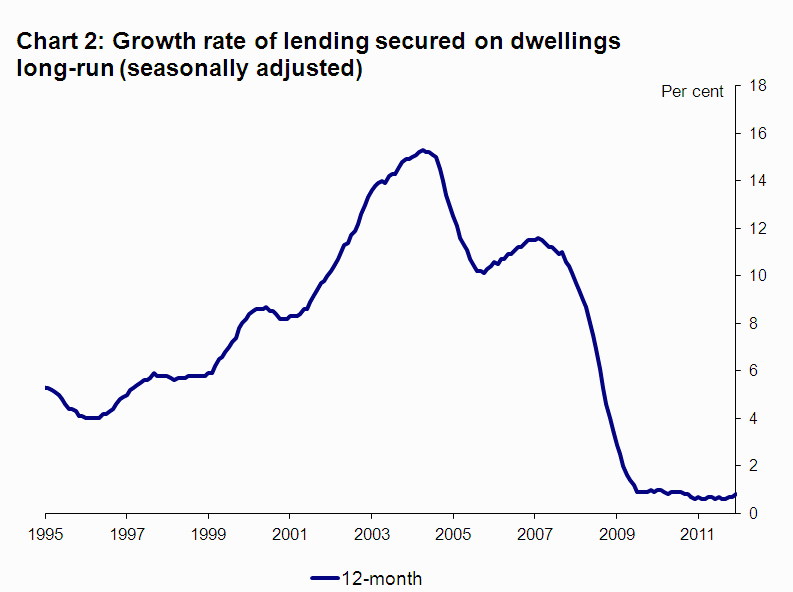
The graph should be self-explanatory, but even some of the big housing charities overlook it. If you allow banks to create money when they make loans, and you allow them to pump the bulk of this newly money into a housing market with relatively limited supply, then house prices will go up. If the level of lending to the housing market is going up at above 10% a year, then we shouldn’t be surprised if house prices rise at 10% or more a year.

At the middle of the house price bubble there was an odd phenomenon from the media; they tended to treat house prices as something out of our control, a bit like the weather. A rising house price was treated like an unexpectedly sunny bank holiday; everyone was expected to rush to take advantage of the opportunity before it was over. I don’t recall seeing any decent analysis explaining that overall, constantly rising house prices simply benefit banks and the few individuals who plan to sell up and move into an old folks’ home or a caravan.

Will House Prices Go Up?

Historically house prices have only started to go up in nominal terms (i.e. the actual selling price) when they have fallen in real terms (i.e. relative to real incomes). In practice, because most people prefer to postpone a house move than to sell their houses at a loss, it means that the house price is ‘sticky’ downwards (it won’t fall as much as it really should). That means only way for houses to become more affordable is for incomes to catch up.

But right now, many private and public sector salaries are frozen. Unemployment is at an all time high (depending on who’s figures you believe). Inflation is pushing up the cost of living, making people poorer in real terms. Houses therefore are not getting more affordable; our incomes are taking a slide backwards and consequently houses are becoming even more unaffordable.

I will state upfront that I’m not in any way qualified to give financial advice, and I’ve never been a big believer in speculating on housing bubbles. But right now what I tell friends who are considering buying their first house is that they should forget any hope of house prices rising significantly in the next ten years. For that reason, they should find somewhere they want to live, that they can comfortably afford on their salary, and see it as a (potentially) more cost-effective alternative to renting, rather than seeing it as a financial investment to make money from.

Hopefully our politicians, policy makers and the Bank of England will start to realise that rising house prices are not helpful to the economy or real people (although they are extremely helpful for the big banks).


  • Dave

    Combine this with students now leaving with a massively increased debt burden there seems little reason to expect increasing leverage in assets.

  • Qualia

    House prices should fall significantly for a few years.
    Even though average salary is £27,000, the most common salary is more like £17,000.
    Therefore if historical correlations of earnigs to house prices are to continue, I would expect to see a fall in average house prices from £160,000 down to around £102,000.
    About a 40% fall.

  • Dhavar

    In Spain the housing bubble was hidden because public statistic shown, f.e., the price of a plot ready to build from one year to another. The difference, though important, was not impressive.
    But the data that was hidden and no one ever made statistics about was the change in price of land, from the point in which it was legally clssified for building to the moment it was ready to build a house on it(sometimes more than ten years.On average, about 3 to 5).

    I worked in that market, and for Madrid the average price increase for that “trip” has been more than 8000% over a period of five years.

    Hence the great fortunes of “building” companies that apppeared out of nothing in those years. They used to laugh about “building houses” and make jokes.Their business was in land.

    By the middle of 2008, the price of land reached in Madrid more almost 70% of the sale price of a house.

  • Conrad Jones (Cheam)

    Hi Ben,

    Good article.

    Here’s something from Steve Keen’s website:

    “There is clearly no capacity for debt service to take a larger slice of the family income pie, which in turn is taking the wind out of the housing market. Spruikers happily make a “supply and demand” argument about why house prices have risen, but obsess about regulation-impaired supply and equate demand with population growth. In fact, demand for housing doesn’t come from population growth: it comes from the growth in the number and value of mortgages. That growth rate in fact peaked back in 2004, and it has been trending down ever since: the First Home Vendors Boost merely delayed this process without stopping it.”

    Steve Keen’s article relates to the Australian Housing Market.

    http://www.debtdeflation.com/blogs/2012/01/07/australian-house-prices-again/

  • http://www.corfudirect.eu Herman Mittelholzer

    An excellent, sensible and well balanced opinion.
    Potential buyers should take note!

  • LH

    Interesting of course but to dismiss consideration of immigration as a factor in this way is a little surprising.

    Firstly, contrary to the bracketed comment a great many of the immigrants moving to the UK are not at the menial level so is not an overall fair representation.

    Of those not looking or unable to purchase, we are already very aware of the massive boom in the buy to let market and the very commonsensical observation that if year on year you bring around 250k people net into a country then this will have an impact on the demand for housing (and on infrastructure, services etc). If access to money is also made easier then both purchasers and professional landlords and B2L will take advantage.

    The House of Lords report on the economic impact on immigration in 2008, had this to say:

    a third of the projected household growth in England over the next 15–20 years is due to net immigration, according to Professor Christine Whitehead of the London School of Economics. Professor Whitehead added that in London about twothirds of the projected increase in households until 2021 will be due to immigration

    • Ben Dyson (Positive Money)

      LH – fair point well made. I was being a little flippant. There are of course other contributing factors, such as issues with planning permission and other issues (which organisations like Shelter cover in much more detail). However the discussion about housing has all seemed to overlook bank lending, or as we would describe it, the creation of new money.

  • Mark Downing

    People gave good advice like this in the early 1990s after a similar property crash. But it all happened again. Banks are too greedy and myopic, to lend like this, and we consumers are also wont to turn a blind eye if it looks like we can make a quick profit.

  • Conrad Jones (Cheam)

    The Availability of money (or credit) I believe is the main reason for the Housing Bubble. The response to this “overpriced” and unaffordable market was more money and credit:

    From the Guardian:
    “Under the HomeBuy Direct scheme, the government and a housing developer jointly fund a loan of 30% of the cost of a property, so that the purchaser only needs to pay a mortgage on 70% of the value. The government allocated £300m to the scheme for 2009-2011. It was intended to provide help for households earning £60,000 or less who could not otherwise afford to buy a property.

    But the IPPR says the biggest beneficiaries have been large housebuilders, which have used the scheme to sell an oversupply of properties, particularly one- and two-bedroom city centre apartments, at a time when house prices have been falling. The result is that the government has in effect propped up weak housebuilders.”

    Labour scheme was called “Shared Equity”
    Con/Lib scheme is called “Home Buy Direct”.

    In both cases, the beneficiaries were not the First Time Buyers.
    Housing Benefits also contributed to the problem by funnelling Tax Payers money into Private B2L Investors pockets.
    The Daily Express estimated the amount of money from beneifts as £20.8 Billion.
    http://www.express.co.uk/posts/view/149567/-20-8bn-cost-of-housing-benefit-20-8bn-cost-of-housing-benefit-20-8bn-cost-of-housing-benefit-20-8bn-cost-of-housing-benefit-20-8bn-cost-of-housing-benefit-20-8bn-cost-of-housing-benefit-20-8bn-cost-of-housing-benefit-20-8bn-cost-of-housing-benefit-20-8bn-cost-of-housing-benefit-20-8bn-cost-of-housing-benefit-20-8bn-cost-of-housing-benefit-20-8bn-cost-of-housing-benefit-20-8bn-cost-of-housing-benefit-20-8bn-cost-of-housing-benefit-20-8bn-cost-of-housing-benefit-20-8bn-cost-of-housing-benefit-20-8bn-cost-of-housing-benefit-20-8bn-cost-of-housing-benefit-20-8bn-cost-of-housing-benefit-20-8bn-cost-of-housing-benefit-20-8bn-cost-of-housing-benefit

    • http://www.corfudirect.eu Herman Mittelholzer

      When the government steps into the market with subsidies it is never surprising when the big developers also step up to use it as a way to inflate prices. The government needs to keep out and allow the market to find its own genuine level, otherwise they just end up, as in this case, making matters worse, albeit perhaps with best intentions as a motivation.

      If the government want to put subsidies to better use they would be wiser to use them to back the positive economy by targeting them toward productive and new enterprises not into fueling artificial property bubbles.

      Investing in the positive economy results in falling unemployment, higher tax returns and lower welfare payments.

  • Mrs Drew

    Perhaps the other trend to be considered is the rise in agency work which is sometimes tempory. There are two forces pulling against one another in the economy. One, the markets who are looking for larger profits from companies who then in turn use agency staff to drive down pay, so the graph of mean pay is going down. House prices mean was going up so there is this large black hole of debt in the middle which I imagine is now being filled by quantitive easing. I may be talking bollocks but as a hedge fund manager noticed this and made alot of money by gambling with this knowledge I just wondered why the powers that be hadn’t noticed this as well.

  • http://www.therowegtraderblog.blogspot.com George Rowe

    Excellent article Ben and delighted the campaign is gaining traction.

  • Pingback: Om bostadsbubblan i England (som spruckit) | dave1bs

Contact Us

You can contact us here.

Search Positive Money

Donate

We rely on individual donors to keep this campaign running. If you can, please help with a monthly or one-off donation.