Watch 97% Owned - the new documentary featuring Positive Money which reveals how money is at the root of our current social and economic crisis.

The general consensus peddled by the media and politicians is that it’s a supply and demand problem – too many people and not enough houses. Some political parties even claim immigration is the cause of higher house prices (despite the fact that while the population grew between 2007 and 2011, house prices fell by almost 10%).

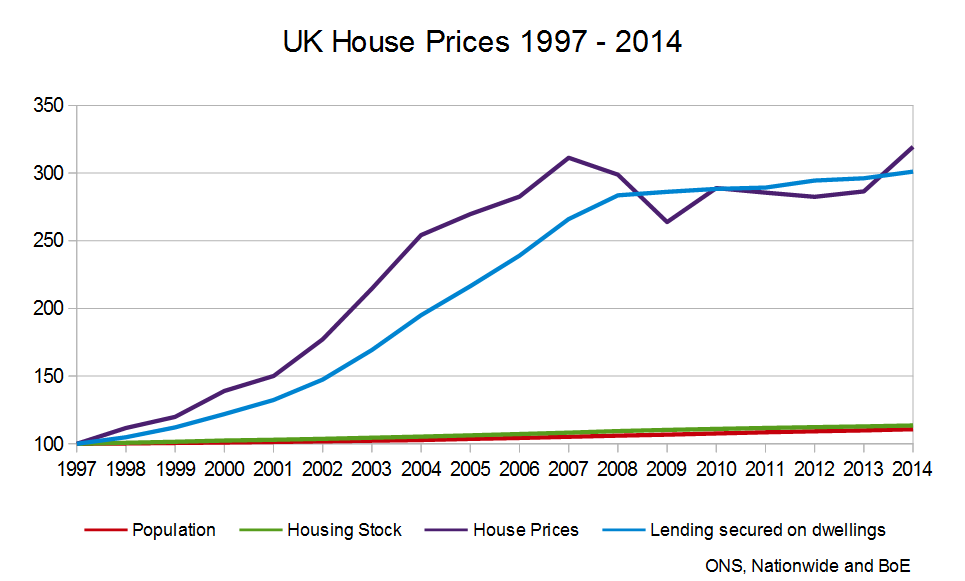
While a lack of construction is undoubtedly contributing to higher house prices in some areas of the country, it is not the key reason for the massive increase in house prices over the past 20 years:With the housing stock actually rising at a faster rate than population it seems unlikely that this is what drove a 350% increase in house prices. Steve Keen, an Australian economist, explains the real reason house prices have risen so dramatically:

Population dynamics – even immigration dynamics – have nothing to do with house prices. What determines house prices is not the number of babies being born, or immigrants – illegal or otherwise – arriving, but the number of people who have taken out a mortgage, and the dollar value of those mortgages. For changes in house prices, what matters is the acceleration of mortgage debt

Steve Keen, House Prices and the Credit Impulse

The chart below shows the evolution of the population, the housing stock, the outstanding lending secured on dwellings and house prices since 1991. While the population and the housing stock remain almost unchanged, mortgage debt has increased rapidly, leading increases in house prices.

Why do increases in bank lending for house purchase increase the price of housing?

When banks make loans for house purchases they create new money for those that take out mortgages. This new money increases the demand for housing. Normally, when the demand for  a product increases, those that make that product increase production. However, due to a variety of factors (including planning regulations, the length of time it takes to build a house etc.) in the UK an increase in the demand for housing hardly increases the number of houses being built (known as an inelastic supply):

Though debt acceleration can enable increased construction or turnover, the far greater flexibility of prices, and the treatment of housing as a vehicle for speculation rather than accommodation, means that the brunt of the acceleration drives house price appreciation. The same effect applies in the far more volatile share market: accelerating debt leads to rising asset prices, which encourages more debt acceleration

Steve Keen, The Debtwatch Manifesto

With no increase in the number of houses to spend the new money on, all the new money goes into buying pre-existing houses. Because more and more money is being created and used to purchase a fixed number of houses, house prices increase. This effect can be shown on a simple diagram:

Money creation for house purchase increases demand (the demand curve, D1, shifts to D2). Because the supply of housing is fixed (at Q), the price of housing increases (from P1 to P2).

That banks creating money for house purchase causes house prices to rise has been shown empirically for the Australian and the American housing market. By Keen’s calculations 78% of the change in American house prices over the past 25 years and 60% of the change in Australian house prices over the past 30 years can be explained by the acceleration in mortgage debt.1

A further problem occurs because house price rises are inherently pro-cyclical. Pro-cyclicality is where an initial increase in something (in this case price) creates the conditions for further (price) increases in the future. A good example of this is speculation – as house prices start rising, speculators buy houses in anticipation of future price rises. Because they borrow from banks to fund their purchases (which create new money when making loans) this pushes up prices even more! As Adair Turner explains in the future of finance (credit is a synonym for money):

We need also to recognise the role that credit can play in driving asset price cycles which in turn drive credit supply in a self-reinforcing and potentially destabilising process. Thus … increased credit extended to commercial real estate developers can drive up the price of buildings whose supply is inelastic, or of land whose supply is wholly fixed. Increased asset prices in turn drive expectations of further price increases which drive demand for credit: but they also improve bank profits, bank capital bases, and lending officer confidence, generating favourable assessments of credit risk and an increased supply of credit to meet the extra demand

Adair Turner, The Future of Finance: The LSE Report

By creating money and pumping it into the housing market, banks not only pushed house prices out of reach of a large proportion of the population, but they also inadvertently created an bubble in the housing market which resulted in a huge debt overhang and a financial crisis. Furthermore, high house prices don’t benefit the population as a whole – they merely transfer wealth from those who do not have a home (usually the poor and the young) to those that do (usually older and wealthier people). The other big winners of high house prices are the banks – higher prices mean customers have to take out proportionally longer mortgages, which leads to more interest payments and higher profits.


Toby Lloyd – Banking behind the Housing Crisis

Toby Lloyd, from housing charity Shelter was speaking at Positive Money conference about the consequences of the current system of money creation by banks on rising house prices, redistribution of wealth upwards, higher inequality and a culture of unearned wealth.

We are redistributing money, very effectively, through the housing system, away from the poor towards the rich, away from the young towards the old, and geographically as well – away from the poorer parts of the country to richer parts of the country.


This system essentially generates the sense of unearned wealth – most people who have done well out of the housing boom have actually earned more by doing absolutely nothing and sitting on their assets than they have from going to work.

  1. Steve Keen, 2011, The debtwatch manifesto. Available at http://www.debtdeflation.com/blogs/2012/01/03/the-debtwatch-manifesto/ []
  • Chris Harris

    The first of your solutions will further inflate house prices. If investments in banks are not guaranteed by government then investors will move their money into property or building societies who will lend more.

    The problem is not the guarantee to small investors but the guarantee to the banks. If RBS had been allowed to fail but the government had made ex gratis payments to all the non banking creditors then the cost would have been less and no moral hazard would have occurred.

    RBS is not Lehman Bros. but it have large casino debts. When Lehman failed all it’s assets were effectively assigned to the receiver who is using them, consuming them, unwinding the inter bank trades – a task it will never complete. If all banks had been allowed to fail and the assets used to pay the non banking creditors it would be found that the losses of one bank were the assets of another. There was no profit on the trades over time, only the bonuses paid to traders were profit to them. This was and remains a very sophisticated bank robbery by the staff in the certain knowledge that the it would be the tax payer not the shareholders that would suffer the loss. Their jobs would be safe. Not the shock of Bearings or Lehmans has frightened the shareholders. A perfect moral hazard.

    Who will put their life savings into such banks without a guarantee? A better solution is a variable transaction tax based on the utility and social responsibility of the transaction. High utility – low tax. A 100% tax on derivatives, commodities an currency speculation would be just the thing to reform the financial system.

  • androo

    Just tinkering Chris and not getting to the root of it. I’m sympathetic to this sites view and probably some of its solutions make sense (I haven’t got to that bit of the site yet). However for me this, http://www.landvaluetax.org/ , gets to the nub of the problem more than anything else I’ve ever come across.

    • Ben Dyson (Positive Money)

      LVT is a great idea, and one that is starting to get a lot more attention. It would do a lot to dampen down the speculative bubbles in housing (which are heavily fuelled by banks creating money). It’s being talked about at a senior level among the Lib Dems and a recent study by the Institute for Fiscal Studies (‘Tax By Design’) came out strongly in favour of it – you can download the report here (see chapter 16).

      • http://www.robertfranklin.net Bob Franklin

        LVT has always sounded a good solution, but whenever it has been tried it has failed, for example by the 1960s Wilson Government, when a ‘Betterment Levy’ was applied to all land receiving Planning Consent. This resulted only in housing plot values increasing by the amount of the levy since landowners were not prepared to reduce their land value uplift, and buyers were, as now, determined to buy into a finite resource thus inexorably raising the purchase threshold for everyone, with a relatively small social benefit.

        Nothing has changed in fifty years other than for house prices to relate ever increasingly to investment value rather than functional value. The IFC report (Chap.16) admits all this, with the only ‘success’ being the miniscule amounts charged for Planning Applications that probably barely return their administration costs.

        Surely larger structural change is required, not least to the fact of farm land increasing in ‘value’ 10,000% the instant it receives housing consent. I’m no Marxist, and this is no doubt naively simplistic, but if a free market existed in all land being leased from the state, value would almost certainly better relate to function rather than investment and ‘profits’ would revert to the state for social betterment. Please tell me where I am wrong here, and not just the obvious one of ‘inalienable rights’ to own land…

        • http://www.landvaluescape.org Tony Vickers

          LVT has never been tried in this country. It was land transaction taxes (Betterment Levy and Development Land Tax) that Labour legislated for. Not surprising they failed: taxing an event (transaction or planning permission) deters such events, whereas LVT encourages optimum use of land by taxing the ongoing rental value year after year – so that people keep using it.

        • Peter Verity

          Land Value Tax has been a success in Pennsylvania, especially Harrisburg.
          See http://www.earthrights.net/docs/success.html

  • androo

    I’ve since read the rest of this site. PM and LVT too for me – either is good alone but together they are the full package.

    • Ben Dyson (Positive Money)

      I agree – the two reforms work really well together.

  • James Norton

    Whilst I see the logic of the argument in a wider sense I think the house price argument weakens the wider issues. A large part of why houses cost a lot is related to the cost of construction, a house built to 1950s standards and 1950s relative labour costs may well be possible to be built for something close to the ‘at current prices figure’. The other issue is the availability and ownership of land, this has a flywheel effect on the total price and is indeed related to the issues you describe and the lack of democracy in UK land ownership. However the stark number comparisons are not in my view valid and most importantly distort the very valid message about the financial system. Most products we buy are affordable and more complex compared to the 50s because we outsource construction to much poorer countries. This is not possible with house construction.

    James

  • Gillian Swanson

    Regardless of the additional cost of building a house,if buyers can’t afford to meet the price asked, there will be no sale.

    Only the fact that lenders are allowed to create brand new money to meet unrealistically inflated asset-price valuations makes it possible for vested interests to keep pushing prices up.

    • James Norton

      It’s not a valuation its a result of the cost of labour and materials, the banking system does make it worse but the price is not totally caused by the banks. The todays prices figure that houses ‘should’ be at is £88k rather than £180k. Assuming the same developed margin, I would estimate however that a house to 1950s standards and labour costs could cost less than 100k.

      If that price is too high without banks then that means that houses will have to be a lot smaller or poorer quality.

      The former may be a good thing but let’s not devalued the main argument by making false comparisons with the 1950s.

      • Archytype

        A big part of the problem arose by property investors borrowing at interest from banks to buy and build. These developers obviously want to make a profit, and their profit must take account of interest on the money they borrowed.

        I would just love to see the data on this, but i reckon most new houses where built by the major builders borrowing to develop in the hope of ever increasing returns.

        The other main contributor is that in 2001 a major shift from traditional pension funds to investing in property took place by people getting buy-to-let mortgages hoping to make money from letting property as their pension.

        All these factors push up prices including sellers’ greed.

        The spiral started….

        • Liam

          Do not forget the impact that planning policy has on house prices. Land with planning permission costs far, far more than land without. Therefore, we can say that a large proportion of the cost of buying some land and building a house is attributable to the way in which local authorities control what is built.

          In general, the authorities would like to see planning permission awarded only to sites within pre-existing areas of development, namely cities, towns and villages. They don’t generally see rural construction projects positively. The effect is that with an ever-increasing population, the developable land within towns becomes dearer and dearer.

          To combat this, I think a far more holistic approach to planning is required, where instead of banning building in the countryside, we encourage genuinely sustainable settlement, with low-impact buildings and the environmentally sustainable use of land. This would reduce house prices for everyone, and benefit our environment, from a local to a global level. That’s my two bob, anyway!

  • Archytype

    Hi Chris, I take you point on what you’ve said.

    However, we are trying to promote a system that does NOT have the government Guarantee the banks! We do not want taxpayer exposure in this regard.

    Investors who put money in to a bank as ‘savings’ want to earn interest and generally Joe Public does not care where the earned interest on their savings comes from.

    That said, under the PM Proposal, bank customers will still have that choice to do this, only their money is not underwritten by the tax payer guarantees the government gives the banks. To put another way, there is NO Depositors Insurance because it would not be needed. The Investors and the Banks SHARE the risk – up or down, good or bad.

    The PM Proposal separates normal Current Accounts from the banks’ ability to use such deposits for its own purposes. Therefor the money held in these accounts is safe and so no government guarantee is needed.

    This money is ‘ring-fenced’ so to speak. It is Fire-walled and can not be used by the banks for lending. This part works on the 100% FULL Reserve requirements.

    As for “Who will put their life savings into such banks without a guarantee?” that’s for individuals to decide. They could leave the money in their “Current Account” earning no interest, or RISK it in an “Investment Account” and try to earn extra money that way. But if it was my Life Savings, I would have it fire-walled off and forego the extra interest in favor of the LEGAL GUARANTEE that the bank can not use it and it would still be there in 10, 20 or 30 years time. Putting it in an ‘investment account’ would risk it being there at all.

    Investors can’t have it both ways, although they try to.

  • Chris E

    I’ve just read some of the LVT information, how is this a good idea? Lets take a couple who worked all their lives, have bought 2 rental properties instead of a pension, LTV is introduced, land is no longer an asset, it is a burden, prices plummet (people with buy-to-lets would be dropping property like hot cakes, the pack of cards would fall below ground level), the couple lose their life savings (one minor and simple example, the knock on effects would be immense). If LTV was to work our whole society and capitalist system would need to be changed, changed so significantly that something like LTV would be ‘small fry’, its like introducing knives and forks to birds – they would have to grow hands and fingers first, which would make the introduction of a knife and fork insignificant, follow? If society was such that LTV could work, LTV would not be required, in fact, money wouldn’t exist at all.

    • Ben Dyson (Positive Money)

      @Chris – it all depends on version of LVT you’re reading. Some ‘absolute’ implications would have all tax revenue collected from land alone, which would be a massive shift (and more disruptive to the economy in the short-term than reforming the monetary system).

      More moderate implications would push up tax onto land values and lower on them on income and taxes, which would do a lot to dampen house price bubbles and hopefully incentivise banks to put less into property and more into business. Banks are inherently incentivised to lend on property over business, so a tax that would counter-balance this incentive should actually help the real economy and create jobs.

      Don’t forget that all investments bear risk, so whatever strategy you use to save for retirement, it might not work out. We’re unlikely to see property prices rise any time in the near future (because real incomes are actually falling). Putting all your eggs in one basket (i.e. rental property) is pretty risky, as is holding your life savings in the stock market.

  • androo

    Chris you seem to be criticising a radical reform (LVT), for being, er radical. And, yes, the whole of society and the capitalist system would be changed – it seems to me that ideas for doing this are precisely what’s needed. Witness todays announcement of help for first time buyers and for developers – off we go again same property merry go round – the current system is bankrupt in more ways than one (http://www.landvaluetax.org/the-lvtc-blog-by-henry-law/welfare-for-the-rich-again.html).

    But, to be clear, LVT is not anti-capital. It’s anti-rent seeking. It’s intellectual champion, the Amercan Henry George, was pointedly pro-trade and pro-enterprise. Actually LVT is compatible with either the big or small government approach to running an economy – on the right are the single taxers, as the name implies LVT is the only tax and all others are abolished while the left would likely keep more of the existing tax infrastructure in place though even they (see labours LVT website) talk of abolishing all current property related taxes as well as VAT and greatly reducing taxes on labour (that is income tax and NI).

    LVT is not an idealists pipe dream. In principle it is a practical and viable way to run a tax system and hence a modern economy. The banking sectors success and importance in the economy shows the weight of rent in the economy and demonstrates rents viability as a tax base for the community as a whole. Of course the problem is getting from here to there. Your objection really is “how rich would a current property owner need to be before a transition didn’t compensate them?” I think not very but clearly that’s an implementation issue to be thrashed out.

  • androo

    LVT will not solve all problems nor settle all arguments but it, and positivemoney, will move us on to a new place in the same way that during the 20th century universal suffrage and political freedom moved us on to where we are now. Next we need real economic freedom. At present the banking system sucks up the excess rent from land values. The old landowners drip feed land on to the market and lifecycle manage their urban land via leases – hoarding it or releasing as suits their interests. The bankers then suck up the rent on that property released into the market during the booms via the interest on the loans that they create from nothing. These then are the rentier classes that OWS and the rest are protesting about.

    Do you imagine that something that isn’t radical is going to succeed in changing this society for the better? After all where we are now looks radical compared with say 400 years back. Except in one crucial element, about 2/3rds of land in the UK is in the same families now as it was 1000 years ago when the Normans produced the Doomsday book, the register that administratively consolidated their conquest of England. I’m not advocating violent revolution. Clearly there is no appetite for that (despite Max Keiser’s interest in a modern guillotine…). But radical administrative and in particular tax reform can do the job. Ordinary people, even the middle class who to some extent, as your comment illustrates, have been co-opted into the rentier class via their property interest, can vote for it – they just need to understand that it is not threat to them – indeed the opposite.

  • androo

    History is not over. Only a few hundred years ago we had a civil war and cut off our kings head. The French went further a little later and the current US union is still young, their civil war was only 150 years ago. The west, despite the pluto/kleptocrats comfort with the status-quo, is a long way from a state of absolute political-economic maturity. If we are to have a more egalitarian society then there must be further change and as land holdings and the banking system are the principle sources of economic inequality they must be the subjects of that change. Maybe the selfish gene is pushing us in the direction of the brave new world (Huxley and all that) – if it is then perhaps it’s inevitable that change will not come about and that society will become more apparently unjust and unequal until we get there. I say apparently as the gene is selfish – is does not care about us per-se – is this the chilling unconscious logic of the pluto/kleptocrats are they blindly gambling that they will be on the right side of evolution. I know how I’d like the story to turn out.

    I haven’t told you about the upside to LVT which is considerable, how it fits in with and complements positivemoney to form a new way of running a modern society that addresses our most crucial and pressing environmental and economic concerns. You can read more about that elsewhere on this site and elsewhere, for LVT take a look at landvaluetax.org.

    • alan

      Good oldfashioned Nationalisation of vital sectors of the economy are needed. Sectors that guarantee our security, insulated against speculative activity. Its totally unnecessary to own a house. The same applies to all the basic utilities. Privatisation has proved more costly and is less efficient. The financial aristocracy are totally deaf to reason.They live on another planet! No ruling class has ever exited the stage of History voluntarily!

Contact Us

You can contact us here.

Search Positive Money

Donate

We rely on individual donors to keep this campaign running. If you can, please help with a monthly or one-off donation.