Watch 97% Owned - the new documentary featuring Positive Money which reveals how money is at the root of our current social and economic crisis.

Inequality: Redistributing Income to the Banking Sector

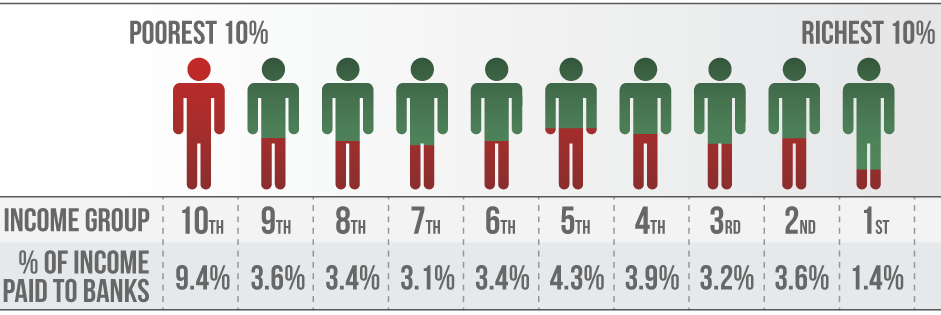
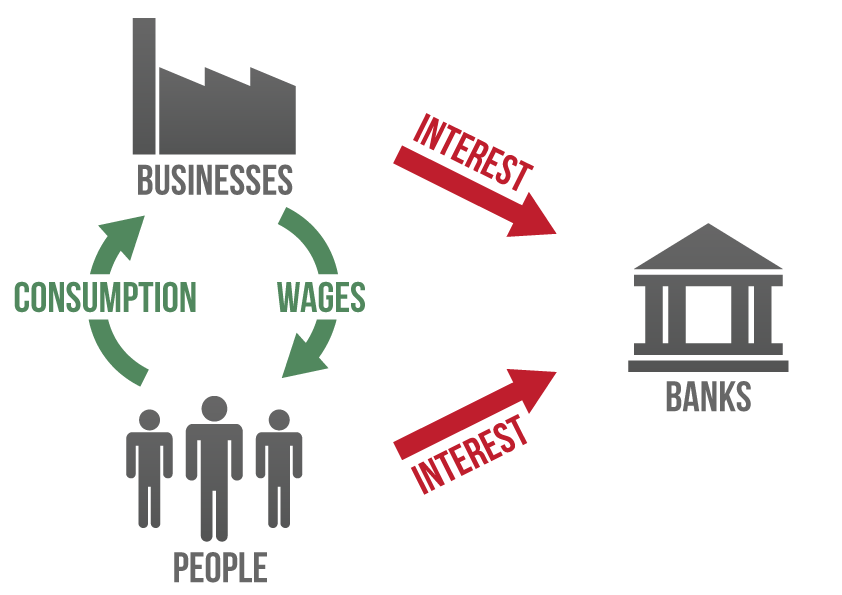
By creating the UK’s entire money supply as loans, the banking sector is able to collect interest at an average rate of around 5% per annum on very nearly every pound in existence. This means in order for the non-banking economy (the other 98% of the UK’s population) to have a money supply with which it can trade, it must pay around 5% of all the money in existence to the banking sector each year. This results in a regular and ongoing transfer of wealth from the non-banking sector to the banking sector.

This generates huge income for the banking sector (imagine if you were able to charge interest at an average of 5% a year on all the money in the UK!).

This system creates three re-distribution effects:

1. From the Poor to the Rich:

All money is created as debt by the banking system. This shifts the ‘baseline’ of poverty down to zero or negative, rather than a low but positive bank balance. Because it is those on below average incomes that end up with much of the debt, they end up paying interest to the banking sector, in effect meaning that the poor subsidise the rich.

2. From the ‘Real’ Economy to the Financial

Businesses are also in a similar situation. The ‘real’ (non-financial), productive economy needs money to function, but because all money is created as debt, that sector will also end up paying interest to the banks. This means that the real-economy businesses - shops, offices, factories etc – end up subsidising the banking sector.

3. From the Rest of the UK to the City of London

Because this debt-based system redistributes money to the banking sector, and the bulk of the banking sector’s salary payments are concentrated within the City of London, this means that there is redistribution of income from the rest of the UK back to the City of London.

All of these re-distribution effects are inherent to the system and will continue year after year as long as the money supply is issued by commercial banks as debt. It is very possible that the ‘upwards-and-inwards’ redistribution of income caused by this system of issuing money cancels out any downwards-and-outwards redistribution of income through the welfare state. Looked at another way, the welfare state may only be necessary thanks to the design of the banking system, and could be significantly scaled back if the method of creating money was reformed.


  • Jav

    I have two queries.
    Is the Bank of England privately owned? (or quasi private). And is it through the BoE Nominee Ltd?
    Isn’t all the creation of money by the BoE created as a interest bearing debt (loaned out to banks? Therefore all ‘cash’ is also a debt?
    The UK national debt – who does the government borrow from?
    Does it borrow £sterling?
    If it borrows from abroad, does it convert the money into £sterling?
    Who converts it and wheredid they get it?

    • Ben Dyson (Positive Money)

      @Jav – The Bank of England is nationalised, and not privately owned.
      Cash is complicated – we’ll have more on this in the coming month.
      The government borrows money predominantly from pension funds and insurance funds. Very little (<5%) of the national debt is owed to the banks.
      It usually borrows in sterling. Foreign holders of national debt usually hold bonds that are denominated in pounds. So the buyer has to buy sterling before it can buy government debt (although usually the conversion process will be automated by the banks that are broking the deals). The conversion from foreign currencies is done via the forex system, which will be explained in a guide that will be published by the New Economics Foundation in September. (Apologies, I don’t have time to explain it all now).

      • Elaine

        The information given on the Bank of England’s web page states that the Bank of England is a corporate body that is owned by Government. According to Blacks Law dictionary a corporate body is a body of a corporation. A Corporation is an organization “the purpose of the organization is pecuniary profit”
        whether it’s private or public, if it’s purpose is to make a profit I ask myself if the bank of England is working for the benefit of the English men and women, or the benefit of the Government? By the way the HMRC, the house of commons, the house of lords, among other Government bodies, are all registered as Corporations – the purpose of which is pecuniary profit.

  • http://jcjpottery.co.uk Jonathan Chiswell Jones

    I thought the Winchester conference was very worthwhile and absolutely absorbing. Adair Turner was fluent and in charge of all his facts, but there wasn’t enough time for him to explain what the problems in changing to a system of 100 percent reserve banking and a total separation of the gambling arms of banks and what one might term the safekeeping arm.

  • Anon

    Most the money is created when we take out a loan or use a credit card. Fractional reserve banking allows banks to create ninty percent of the money out of thin air. There is a good video on YouTube called “Debt as Money” which explains the system.

    • Anon

      If the fractional reserve is 10:1 doesn’t that mean there are really 10 people in debt for every 1 person debt free.

  • http://notyet Lionel Ashley Vye

    been following your campaign now for about a year ben, i’d be interested to here if this could fit in with your plan

    http://www.eudebtwriteoff.com/

  • Patrick Mockford

    If Europe leverage their 440bn euros to 2 trillion; who will the lender(s) be? It seems to me that a vast loan of this magnitude, if part lent to sovereign debt defaulters, eg Greece, maybe Italy, Spain,or Ireland is like pouring petrol to dowse flames. Won’t it all go up in smoke?

  • David Wellman

    I can’t follow this: “Note that the debt cannot fall by any significant amount… In a recession people tend to borrow in order to stay solvent, so increase their level of debt once again”.
    However, if the level of debt is already so high that people can’t borrow more anymore, this must lead to a deflationary spiral.

    • http://www.facebook.com/groups/327886425672/ Joseph Hitselberger

      That seems to have been written in haste. Your spiral comment is a dead-on description of what Irving Fischer called debt-deflation. It may have been better to say that when debt decreases by a significant amount, it can cause debt-deflation (depression, recession etc.).

  • Nigel Photon

    Surely Ben Dyson is wrong. There are nominee shareholders of the Bank of England and a % of the banks profits is paid to them. Therefore if there are private shareholders it is not effectively nationalised!

  • David

    As I recall, the consumer society was encouraged by Reagan and Thatcher in the mid eighties and the main tool they used was to de-regulate the banks. That was the start of the virtual money problem. Spending was encouraged I believe to oil the wheels of the economy and hugely increase to government’s tax take from indirect taxes especially VAT.
    Credit cards could not have been facilitated so easily without virtual money and capitalism has been ratcheted up, for example, by legitimising the apparent need for public companies to increase their profits year on year until they reach to stage that to achieve the necessary profits they sack large numbers of staff! Now we have arrived at this false and unrealistic position caused by following the virtual money trail we are being forced into a debt amnesty, probably by the USA who have the most to gain from such an amnesty and to do so are destabilising the Euro to nudge western public into accepting a financial realignment on an unbelievable scale.

    • David

      What is immoderate about the comment?

      • http://www.facebook.com/groups/327886425672/ Joseph Hitselberger

        It sounds a bit conspirical. Reagan and Thatcher were doing what they thought was best for the economy. The “false and unrealistic” position has been caused by a lack of knowledge of better alternatives. Those alternatives are provided here, in spectacular fashion. If correct, this is the most significant economic model in world history. The principals won’t say that, but I will say it for them. The ideas advocated here have the potential to be the most significant economic ideas of all time.

  • João

    What about inflation?
    Notice that “print money and give it away” is something that happened several times in history always with the same result – the poor got more poorer, the ones controling food and ohter goods got more rich.
    This doesnt imply i do not agree with you about modus operandi of the scheme going on between governments and banks.

    • Mira Tekelova (Positive Money)

      @João There is absolutely no risk of this happening in the environment created by this reform. For one thing, decisions on changes in the money supply will be made not by vote-seeking politicians but by an independent body (the Monetary Policy Committee). Politicians will have no influence whatsoever in the amount of money that will be created. Please read more here: http://www.positivemoney.org.uk/our-proposals/how-do-we-stop-inflation/ and here: http://www.positivemoney.org.uk/draft-legislation/part-3-monetary-policy-committee/

      • http://www.facebook.com/groups/327886425672/ Joseph Hitselberger

        I would add that inflation would be theoretically easier to control with positive money. The quantity of lending is a much harder animal to control in the present environment. We see this lack of control in housing prices.

        Positive Money is a better concept, but not riskless. However, no one expects the MPC to make botched evaluations. It would for instance, be completely against stated policy to add positive money into an environment of loose credit (which actually would be highly inflationary). They know what to avoid.

Contact Us

You can contact us here.

Search Positive Money

Donate

We rely on individual donors to keep this campaign running. If you can, please help with a monthly or one-off donation.